Congratulations, Dr. Chiang!
July 11, 2025
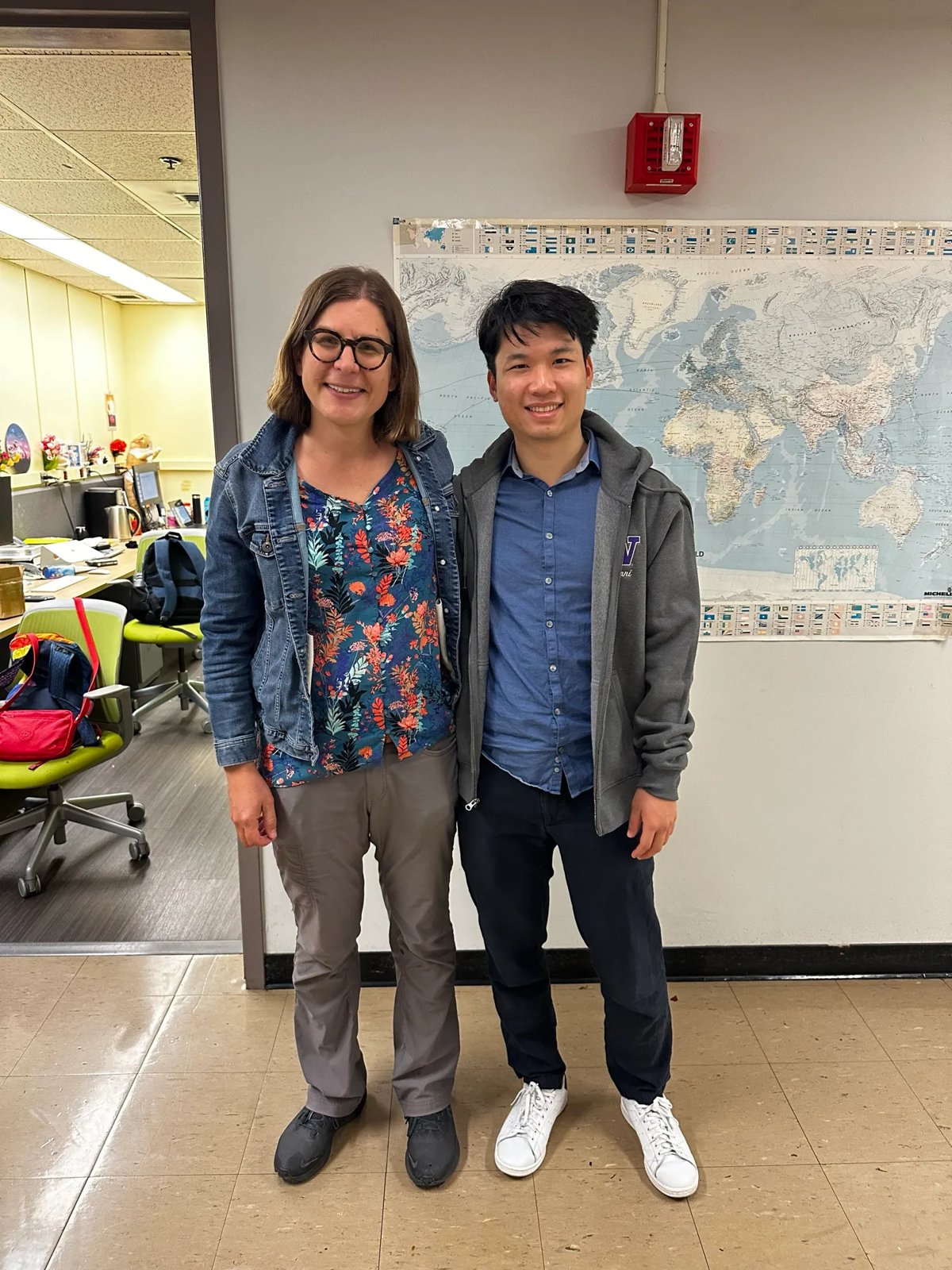
Huat Thart Chiang successfully defended a dissertation titled “Data-Driven Analysis of Experimental Design Spaces for Colloidal Synthesis and Assembly” on July 11, 2025, at the Molecular Engineering & Sciences Institute. Huat is the 17th PhD student to graduate from the Pozzo group, and now holds a PhD in Chemical Engineering.
Huat’s work used automation, scattering, and spectroscopy to optimize the synthesis and assembly of colloids, combining self-driving laboratories with interpretable AI to navigate complex experimental design spaces. The dissertation is available in ResearchWorks. Publications from this work include “Data-driven exploration of silver nanoplate formation in multidimensional chemical design space” (Digital Discovery), “Efficient analysis of small-angle scattering curves for large biomolecular assemblies using Monte Carlo methods” (Journal of Applied Crystallography), and “Assembly of small silica nanoparticles using lipid-tethered DNA ‘bonds’” (Soft Matter).
Read the dissertation abstract
Colloidal nanomaterials offer diverse functionalities driven by their structural properties, requiring precise control over synthesis and assembly. Due to the complexity of the experimental design space, a self-driving lab approach, which combines artificial intelligence (AI) with autonomous experimentation, is a powerful method used to navigate it. In this approach, an AI agent selects and evaluates experiments in a closed loop, progressively improving its understanding of the design space as data is collected. Some ways to improve self-driving labs include improving the distance metric to enhance the system’s ability to guide synthesis. In this work, the amplitude-phase distance metric is introduced, which captures shape differences in functional datasets (e.g., UV-Vis Spectroscopy, SAXS). Its performance is compared to the Euclidean distance metric, and key differences are observed in nanoparticle structural differentiation. Further advancements in self-driving labs include using multiple characterization methods (UV-Vis, SAXS, TEM), minimizing reliance on literature for design space definition, and employing interpretable AI to extract experimental insights. These improvements are demonstrated with another self-driving lab tested with silver nanoplate synthesis, where the derived design rules align with established knowledge. In addition to inorganic nanoparticle synthesis, this work also explores engineering stimuli responsive protein assemblies, which was done by modifying the RhuA protein with light and chemically responsive molecules. Structural analysis via a Monte Carlo-based SAXS fitting method reveals light-controlled assembly into tubes or sheets, influenced by solution ionic strength. Finally, we explore DNA-mediated assembly of lipid encapsulated nanoparticles where high-throughput experimentation is used to identify the effect of design variables on the final assembly.
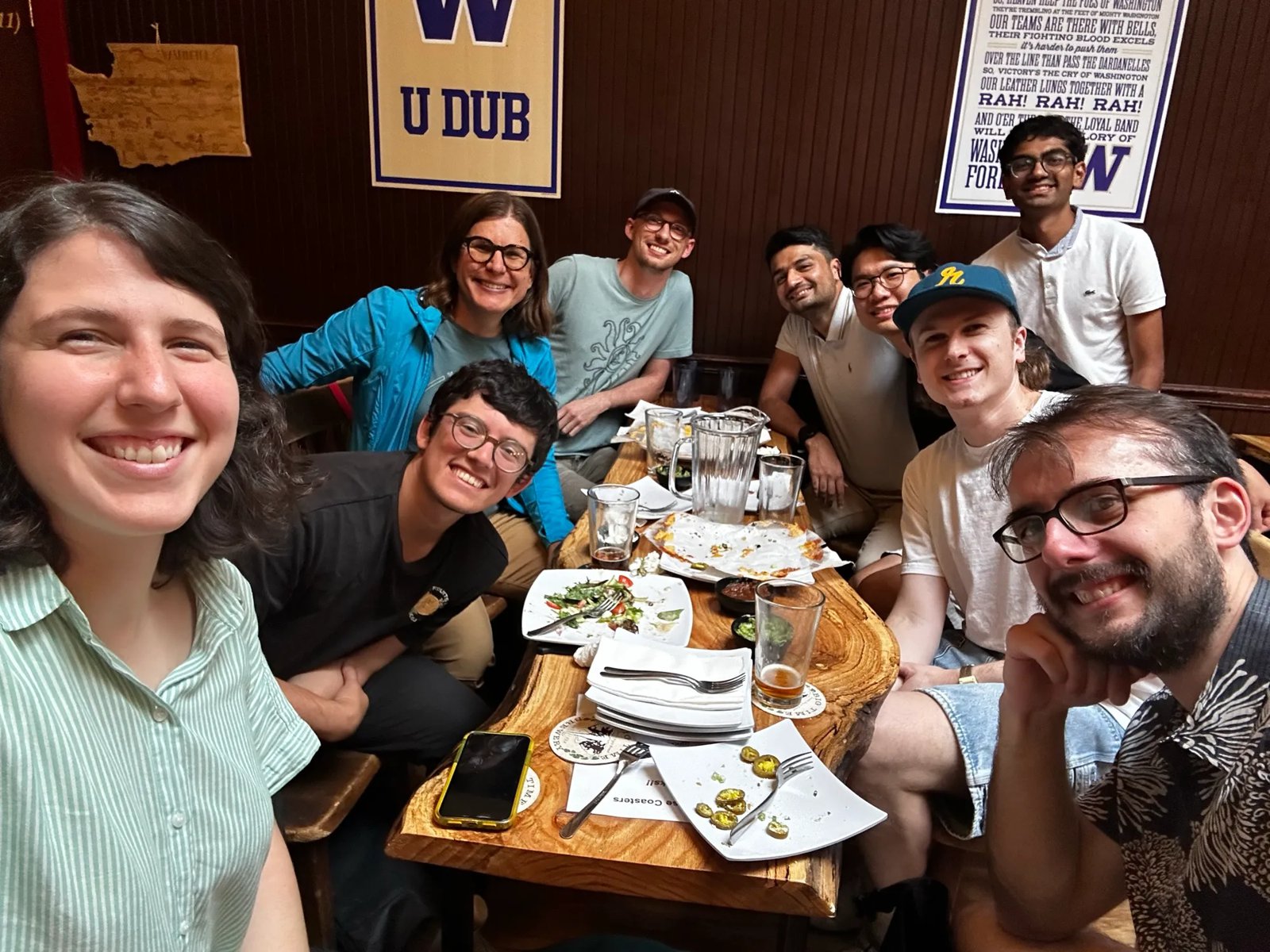
In August, the group gathered to say farewell to Huat and to Christopher Gould, who completed an MS degree. We will miss you both in the group and look forward to hearing about your adventures!
Congratulations, Dr. Chiang!
Connect with Huat: LinkedIn · ORCID