Congratulations, Dr. Li!
October 6, 2025
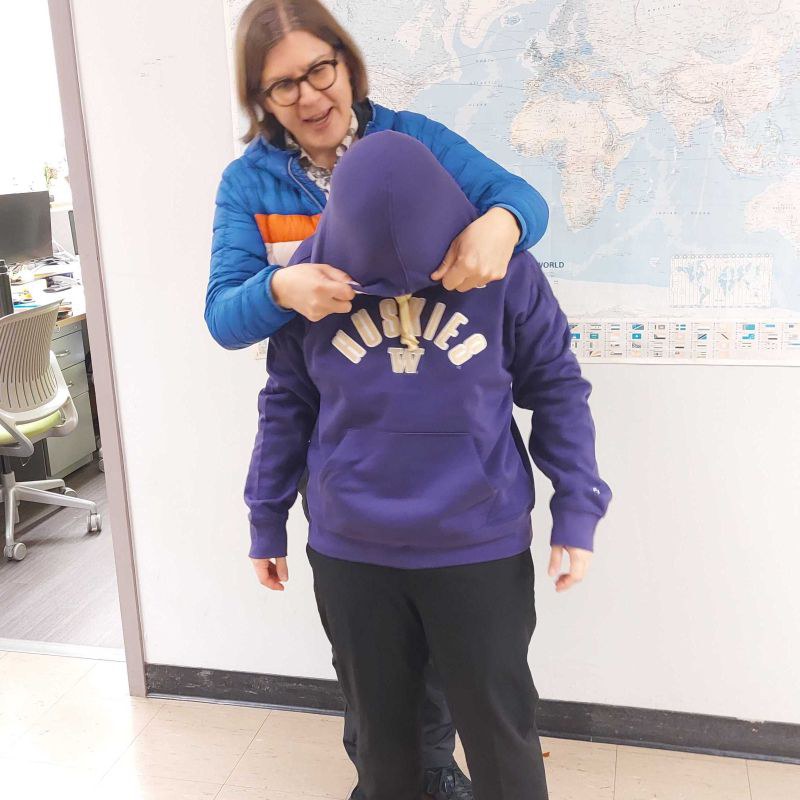
Karen Li successfully defended her dissertation, titled “Block Copolymer and Conjugated Polymer Blends for Mixed Conducting Materials,” on October 6, 2025, at the Molecular Engineering & Sciences Institute. Karen now holds a PhD in Chemical Engineering.
Karen’s research improves our understanding of the science and engineering of blends of conjugated polymers and block copolymers, materials important for technologies ranging from bioelectronics and organic electrochemical transistors to sensors and electrochemical storage devices. Her work addressed fundamental questions about the morphological transitions that occur when stiff conjugated polymers are blended with self-assembling block copolymers, finding that their integration biases the blends toward extended morphologies such as cylinders and lamellae. Karen also integrated automation and autonomous experimentation with small-angle X-ray (and sometimes neutron) scattering as a fast way to analyze sample structures and map phase diagrams, an area of rapid growth to which she has been an integral contributor in the group.
The dissertation is available in ResearchWorks (full text restricted to UW users until February 2027, then open access). Part of this work is published in Macromolecules: “Self-assembly of a Triblock Copolymer in the Presence of a Rigid Conjugated Polyelectrolyte”.
Read the dissertation abstract
Organic mixed ionic electronic conductors (OMIECs) are organic materials that conduct both ionic and electronic charge carriers, with growing applications ranging in batteries, biosensors, neuromorphic computing devices, and more. A major challenge of organic mixed ionic electronic conductor (OMIEC) material design is the opposing preferred morphologies of ionic and electronic transport, where ionic conduction prefers amorphous structures while electronic prefers crystalline ones. New OMIECs often require complex synthesis processes to integrate all desired properties within the material. This work investigates an alternative approach by blending components to modify compositions of composite OMIECs can greatly simplify and accelerate the molecular design process to achieve material solutions via careful (re)-formulation. Blending self-assembling block copolymers (BCPs) with relatively rigid conjugated polymers (CPs) offers a strategy to facilitate long-range ionic and electronic transport in a new class of structured OMIEC blends. The morphology and order of these blends are influenced by several parameters, including temperature, concentration, molecular weight, side chains, shear, etc.
We first investigated an aqueous blend of a triblock copolymer and a conjugated polymer to examine how the self-assembled phase structures of the triblock copolymer evolve with the addition of the conjugated polymer under varying concentration, temperature, and shear conditions. The presence of the conjugated polymer was found to discourage a cubic phase and instead promote an elongated morphology, favoring a hexagonal cylindrical phase. Morphological characterization of OMIEC blends was extended to systems composed of high-χ parameter block copolymers and multiple conjugated polymers, examined both individually and as blends in solution and solid-state films. We found that that apparent co-assembly in solution did not necessarily predict intermolecular mixing in the solid state. Instead, the architecture and molecular features of the block copolymer governed whether the conjugated polymer was incorporated into the self-assembled structure. Finally, the influence of polymer architecture, solvent, and concentration on the mixed conduction of OMIEC blends was investigated using a self-driving laboratory equipped with robotic platforms for automated device assembly and analysis. Among the parameters studied, the concentration of poly(3-hexylthiophene) (P3HT) was found to have a dominant impact on mixed conducting performance. Overall, these studies highlight the complex interplay of composition, morphology, and processing in OMIEC blends, offering insights that can guide future materials design strategies.
Karen’s graduate experience was enriched by collaborations with Jie Xu at Argonne National Laboratory, Jitendra Mata at ANSTO, and Christine Luscombe and Matthew Golder at the University of Washington. Thank you to everyone who was part of Karen’s journey.
Congratulations, Dr. Li!
Connect with Karen: LinkedIn